Survival of the Fittest: How Threatened Freshwater Mussels are Optimizing Their Chances of Survival
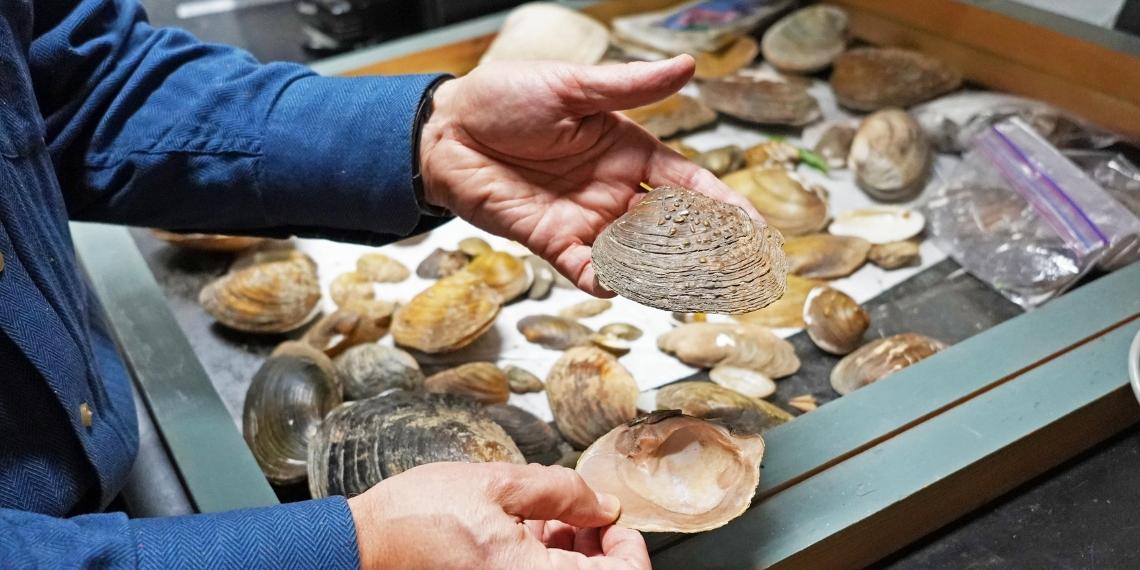
Those interesting rock-like creatures once commonly found in lake and riverbeds are becoming harder and harder to find. Many of the species are now listed as Species at Risk. Habitat loss, pollution, and invasive newcomers have made their outlook suddenly uncertain.
Faced with these challenges, wouldn’t you do everything you could to survive against the odds?
A new study by graduate student Stephanie Smodis and Dr. Josef Ackerman from the Department of Integrative Biology, along with colleagues from Fisheries and Oceans Canada, has revealed an unexpected reproductive strategy in one of the most endangered groups of organisms on the planet: freshwater mussels.
Of the 55 species of freshwater mussels found in Canada, 41 reside right here in Ontario. As suspension feeders, these mussels not only play an essential role in maintaining water quality but are also part of the food chain, serving as prey for a variety of animals like catfish, otters, and even diving ducks.
However, deforestation, farming, and agricultural activities in watersheds pose a serious threat to their survival. And the arrival of invasive zebra mussels into the Great Lakes ecosystem has further stacked the deck against these important ecosystem engineers, especially in lakes.
So, what’s a mussel to do? The answer, it turns out, is tied to their rather unique life cycle.
Freshwater mussels require a fish host to complete their development, acting much like parasites in this regard. Adult mussels release larvae known as “glochidia,” which latch onto the gills or fins of passing fish. Here, they metamorphose over a period of weeks or months into juveniles, before detaching and returning to the riverbed to further mature.
Previous work in the Ackerman lab has identified the fish species targeted by different mussel species and which mussel-fish pairings result in successful reproduction. During this process, they noticed that glochidia of certain mussel species were more abundant at certain times of day. In the current study, Ackerman and colleagues set out to capture the specific timing of these occurrences.
“There can be a multitude — over 25 species — of mussel species in one river system and they don’t all reproduce at the same time,” explains Ackerman. “We were curious as to why this might be, and to determine the implications for their life history and conservation.”
Most studies have looked at mussel reproduction over long time periods, including months and seasons. This study is the first of its kind to investigate the relationship between mussels and their host fish over a much shorter time period — specifically, within a 24-hour or daily cycle.

Ackerman and the "rosette sampler,” a custom-built device with12 cylindrical chambers programmed to open and close sequentially, allowing for the collection of glochidia from the water every two hours over a 24-hour period.
 In collaboration with the University of Guelph’s Physics Machine Shop, Ackerman developed a “rosette sampler.” This custom-built device consisted of 12 cylindrical chambers, placed in a rose pattern, that were programmed to open and close sequentially, allowing for the collection of glochidia from the water every two hours over a 24-hour period.
What they observed was quite puzzling — at least at first.
“Some glochidia were more abundant than others, and their pattern of occurrence in time did not fit any previously known models. Was it random? Was it uniform? Was it clumped? None of these models fit,” explains Ackerman.
Instead, the abundance of glochidia appeared to coincide with when the fish that they target as hosts are most active, presumably increasing the likelihood of glochidia finding and latching onto a suitable host. With the odds stacked against them, it is a strategy that may increase their reproductive success and overall survival.
Even so, there are more mussels than potential hosts, and some mussel species share the same host fish. Interestingly, mussel species competing for the same host fish released their glochidia at different times of day, as if attempting to partition the available resources.
“It appears that different species of mussels have created a ‘separation in time’ — even within a relatively short 24-hour period — to minimize competition for hosts during reproduction,” says Ackerman. “This approach could ultimately be what allows multiple species of mussels to coexist in the same habitat.”
In addition to uncovering a fascinating reproductive phenomenon, the study can inform conservation strategies for at-risk freshwater mussel species. For example, reducing aquatic and light disturbances during peak periods of glochidia abundance for threatened species may help preserve these carefully partitioned reproductive periods.
The team hopes to build upon this research by investigating what mechanisms trigger glochidia release and the overall reproductive success of this process, adding to the conservation arsenal for these resilient creatures as they try to survive against the odds.
Read the full study in Scientific Reports.
Read about other CBS Research Highlights
 .
.