Keep Your Ear to the Ground: How Soil Fungi Redefine Plant Response to Climate Change
Beneath our feet lies a world that is vital to the survival of plants. Look closely, and among the more familiar worms and insects you will find countless microscopic organisms that help plants survive in a myriad ways. These include mycorrhizal fungi, a type of fungi that attach to roots and give plants better access to water, nutrients, and minerals. In return, the fungi get carbon compounds essential for their own survival.
It’s a mutually beneficial relationship — or mutualistic symbiosis — that can be found in the vast majority of plants, and one that evolved over 500 million years ago. But, more recently, human activities have raised global temperatures and carbon dioxide levels, putting plant species under increasing stress while also increasing plant carbon fixation. Can this partnership last in these altered environments?
This question guided the work of Dr. Hafiz Maherali and postdoctoral fellow Dr. Andre Duarte in the Department of Integrative Biology. In a recent study published in the International Journal of Plant Science, they investigated how plants respond under a variety of stressful and altered resource conditions — both with and without the presence of arbuscular mycorrhizal (AM) fungi.
“Soil biota is everywhere,” says Maherali. “You can find bacteria and fungi in soil from a parking lot to agricultural fields that have been fertilized for decades.”
 Yet climate change and human activity are altering the biotic community. Fertilizer runoff, for example, changes the nutrient availability within the soil and reduces mycorrhizal fungal diversity and abundance, potentially causing significant biological disruption.
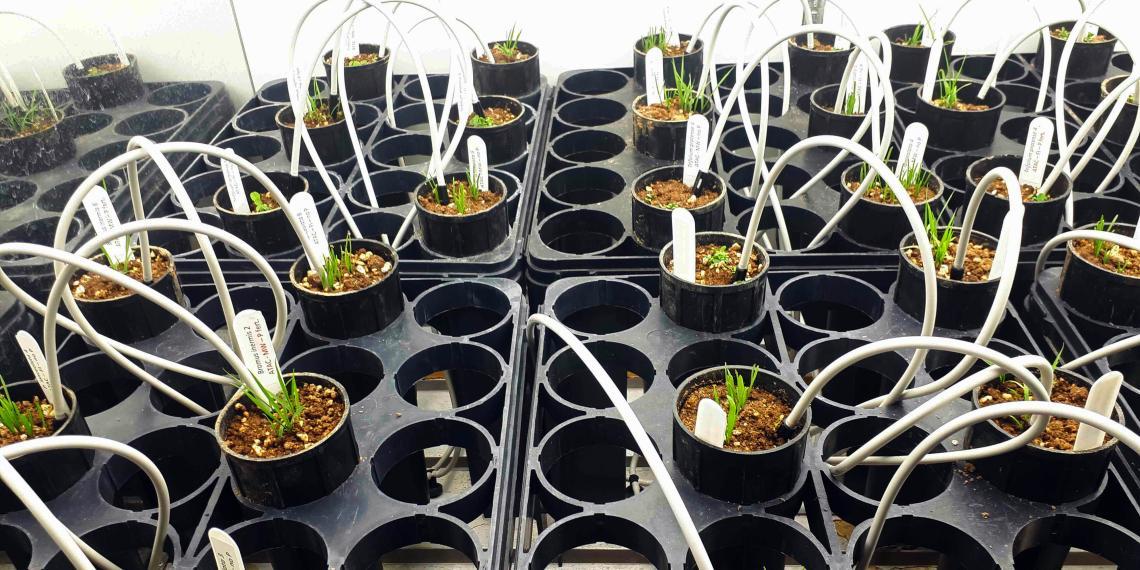
To explore these dynamics in a changing world, Maherali and Duarte focused on three common plants: red clover, narrowleaf plantain, and switchgrass — all of which are abundant across southern Ontario. They grew the plants in soil taken from the University of Guelph Arboretum, a site where Maherali’s group had previously identified the soil microbiota.
They also grew another batch of plants in the same field soil — but with the mutualistic microbes filtered out, simulating a loss of AM fungi.
The first factor they looked at was how the presence or absence of AM fungi in the soil influenced the impact of fertilizer. While the fungi are known for enhancing nutrient uptake, Maherali and Duarte found that their presence did not alter the benefits of fertilizer on plant growth. This suggests that fungi have additional roles that influence plant growth beyond improving nutrition.
“When AM fungi colonize the root, it is possible that they’re preventing pathogens from colonizing,” explains Maherali. “This suggests that even when lots of nutrients are around, they still provide another valuable service to the plant.”
The team also assessed plant growth in both soil types under high carbon dioxide and high temperature conditions, both individually and in combination. Here, their results showed that the plants’ responses were far from uniform.
For instance, red clover grew less under high temperatures and raised carbon dioxide, but only when AM fungi were present. In contrast, switchgrass grew about the same across all conditions when all soil biota were present. When fungi were absent, however, growth varied depending on the treatment.
The bottom line? Soil biota can amplify or weaken the effects of high carbon dioxide and temperature on plant growth, and this influence differs between plant species.
“What this tells us is that we can’t rely on a response from a representative species and assume this is how all plants will respond,” says Maherali. “It’s quite complex.”
These multi-factor experiments were made possible by the controlled environments at the University of Guelph Phytotron, where Maherali serves as director. “This facility allows us to manipulate temperature and carbon dioxide very effectively, along with the excellent support of its staff members.”
The study illuminates the hidden ecosystems that support and maintain plant life.
“There is so much yet to be discovered about what is happening between plants and the soil that they live in,” Maherali says.
As the scientific community continues to untangle how plants, animals and microbes are most likely responding to climate change, the study serves as an important reminder that there is an important and diverse world within soil, filled with microbial diversity that supports life-sustaining interactions across the biome.
Read the full study in the International Journal of Plant Sciences.
Read about other CBS Research Highlights.