The Secret Lives of Serengeti Lions: How Large Lion Prides Thrive Against the Odds
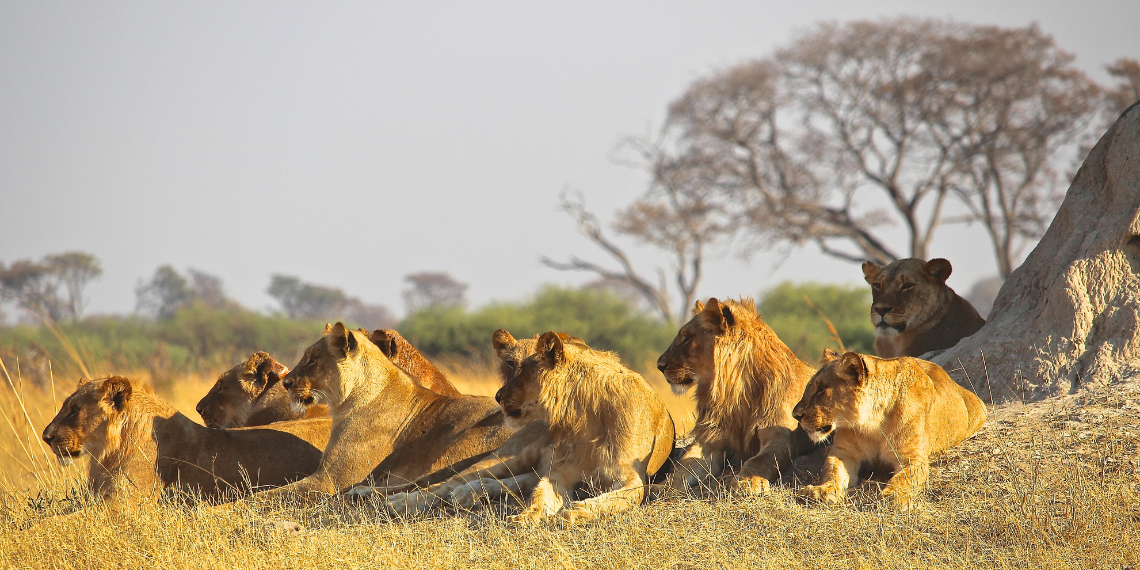
Many animals live their entire lives in social groups, but how much do we really know about how these groups function?
For prey animals, living in groups is a common survival strategy — there is safety in numbers against predators. But things get more complicated when wild carnivores form social groups. Wolves, lions, hyenas, and even orcas are known to live in groups, even though this behaviour often results in each individual getting less food per kill.
As a result, ecological theory predicts that large groups of carnivores should not be sustainable. And yet, lion prides in the Serengeti defy such assumptions, with some prides exceeding 20 members.
A recent study led by Dr. John Fryxell, Department of Integrative Biology, has shed new light on this long-standing puzzle. According to Fryxell and colleagues, the Serengeti’s large prides thrive by separating into smaller hunting groups, then reconvening with the entire pride. But there’s a surprising twist: these small groups of hunters don’t usually work collaboratively.
“The Serengeti is one of the greatest wonders in the world, home to some of the world's most iconic mammals. But we are still learning about the complex processes that shape and maintain this ecosystem’s unique biodiversity,” says Fryxell.
Fryxell’s research program focuses on animal movement and behaviour, with a particular focus on how consumers — whether they are carnivores or herbivores — interact with their food sources. He has studied mammals all over the world, including Africa, where he’s been conducting research since the 1980s.
 His most recent study, published in Ecology Letters, set out to address a fundamental question: How do large lion prides remain stable in the Serengeti, and how does this affect hunting rates?
In the field of animal biology, there is a large body of research on “fission-fusion” group dynamics — the name given to the fluid process of social groups forming, separating and re-forming. Most of this research has focused on the distribution of group sizes, but not how this phenomenon may affect hunting.
Fryxell’s study took advantage of long-term data on the size of lion hunting groups in the Serengeti that was collected using radio collars fitted to female lions over the course of 12 years. The team used the data to model how changes in group behaviour would affect hunting efficiency, using wildebeest as the model prey species.
Two theories were tested. The first theory was that lions hunting in groups cooperate to catch more prey, meaning hunting success could be largely improved by group cooperation. The ability to catch more food would thus allow each individual to eat more.
While it’s a logical theory and likely true for some predatory species, the model found this is not the case for Serengeti lions.
“It’s appealing for us as humans to see hunters as super cooperative and successful, but it’s actually quite rare,” says Fryxell.
The second theory — and key argument of the study — is that large groups of lions split temporarily into smaller subgroups to hunt more efficiently. After they obtain enough food, they return to the main group, where they benefit from information sharing, cooperative rearing of offspring, and group defence of their territory.
The model showed that this second theory was in fact the most likely case for lion prides in the Serengeti, and the predominant way that large prides were able to remain stable.
The study provides a nuanced look into social groupings that has several practical applications. For example, it can help wildlife managers to better anticipate the outcomes of their interventions in an ecosystem facing many threats. It also underscores the need for ecologists and conservation biologists to place more of an emphasis on social aspects of wild animals, as they are clearly an integral part of natural processes.
Beyond these applications, studies like this also help pull back the curtain on the magic and wonder of wildlife. Says Fryxell, “It’s a reminder to all of us to rejoice in the subtle aspects of the hidden lives of animals.”
Read the full study in the journal Ecology Letters.
Read about other CBS Research Highlights.