One Gene, Two Gene: A ‘Hyper’ Cool New Tool for Research of Drug-Resistant Fungal Pathogens
In the world of antimicrobial resistance (AMR), bacteria usually get the spotlight. But among the cast of concerning organisms, another formidable force is quickly gaining notoriety: the fungus Candida albicans.
C. albicans is an opportunistic pathogen that can cause life-threatening infections in immunocompromised individuals. Unlike bacteria, however, fungi have a surprising genetic similarity to us, making them especially problematic to treat — it’s difficult to design a drug that targets the fungus without also harming our own cells. As a result, there is a very limited number of drugs available to treat these infections.
As antifungal resistance continues to increase globally, researchers at the front lines of AMR require innovative genetic tools to answer fundamental questions about this pathogen and how it is able to overcome antifungals.
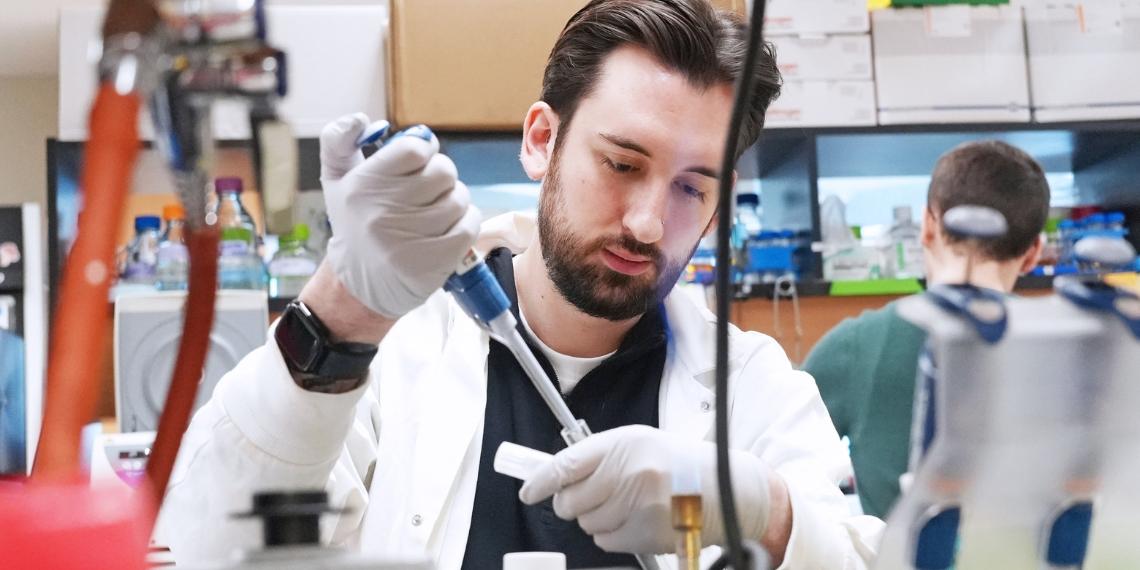
Dr. Rebecca Shapiro and PhD candidate Nick Gervais in the Molecular and Cellular Biology department set out to address this issue by developing a powerful new tool that allows them to manipulate multiples genes at the same time in fungal pathogens. This advance is an essential step forward in understanding what drives the emergence of resistance to antifungal drugs.
Traditionally, researchers have targeted one gene at a time: by turning the gene on and off, they can describe its effect. But in reality, genes rarely function in isolation. They are part of a network of genetic interactions that give rise to complex traits like drug resistance.
“Our current understanding is based on how single genes contribute to a characteristic. However, the real mystery is how they can work together with other genes,” says Gervais. “There are many basics still to learn, but tools available for fungal pathogens are lagging compared to those for bacteria and human research.”
The new tool is an enhanced version of the CRISPR gene modification system. Over the last decade, CRISPR has exploded in popularity due to its incredible precision and versatility.
Most of us are familiar with the term, but what exactly is CRISPR? Put very simply, it is what acts as an immune system for bacteria.
Just like humans, bacteria can be infected with viruses. But unlike us, bacteria retain fragments of genes from these foreign invaders and store them in a small memory bank within their own DNA. The bacteria then use these fragments to identify any genes floating around the cell that match with the invader’s genes. In the event of a match, bacterial enzymes known as “Cas” enzymes will destroy the invading genetic material to prevent infection.
 Researchers have figured out how to exploit the CRISPR system by modifying the Cas enzyme to target any gene in virtually any organism. These enzymes can be used to either cut the gene (like a pair of molecular scissors) or block to the gene (like a molecular hockey goalie), to turn it on or off to reveal its function.
The Shapiro lab has an impressive track record of developing new CRISPR tools for the study of fungal pathogens, and their latest effort is no exception. The “secret sauce” of their new CRISPR tool lies in the Cas enzyme itself; it is based on a “hyper-efficient” version that, unlike other CRISPR tools, can easily target multiple genes at once. This capability opens the door to looking at interactions between different genes.
“This is the first CRISPR system for a fungal pathogen where we can easily regulate multiples genes at once to turn them on or off,” explains Gervais. “Until now, we lacked this ability for this important group of pathogens.”
Gervais tested the new system in C. albicans by using it to repress two different genes involved in the production of ergosterol, a molecule that plays a role in the cell membrane of the fungus and is a key target of a commonly used antifungal drug.
While targeting either of those genes alone led to a small or negligible increase in resistance to the drug, repressing both genes caused an extraordinary increase.
“This work demonstrated a massive, scary level of drug resistance that these fungi may naturally acquire that we wouldn’t have identified if only one gene had been targeted,” says Gervais.
The new CRISPR system offers researchers the ability to probe the complicated world of multi-gene interactions, with implications not just for antimicrobial resistance but also host-pathogen interactions.
“Our goal is to take this research from the petri dish to a mouse model to understand what happens with these genetic interactions when pathogens are exposed to many stressors simultaneously within a host,” says Gervais. “This could lead to combined therapies down the line as we learn more about these networks.”
Read the article in Nucleic Acids Research.
Read about other CBS Research Highlights.