Feeling the Heat: What Beetles Reveal About Range Expansion in a Warming World
For many animals, dispersal is a necessary way of life. They must move across the landscape to find food, mates or suitable habitat. Now, decades of climate change are raising the stakes even further. As temperatures continue to rise globally, many species must leave behind or expand their native ranges to ensure survival.
But how exactly do rising temperatures affect animal movement and dispersal? It’s a question of growing importance, as these range shifts can have major ecosystem-level impacts and can determine whether an organism persists or goes extinct.
Previous research has found that warming temperatures can prompt animals to shift their ranges, but there is a critical gap when it comes to understanding how fast these changes may occur, and the mechanisms that drive them.
 A recent study published in Ecology and led by Kayley Breslin, an undergraduate student in the Wildlife Biology and Conservation program, and Dr. Tess Grainger, a professor in Department of Integrative Biology, delved into this phenomenon.
According to Breslin, there are two main ways that temperatures can speed up range expansions: through increased movement and increased population growth.
“Understanding how, and through what mechanisms, warming temperatures affect the speed of animals expanding their range is critical for predicting shifts in species distributions under climate change,” says Breslin.
With a passionate interest in how species movement is impacted by climate change, it was a natural fit for Breslin to partner with Grainger. The Grainger lab focuses on the effects of global change – in particular, changing temperatures – on a variety of ecological and evolutionary processes.
The pair set out to address two fundamental questions: How does temperature affect the speed at which animals expand their range? And what factors drive this effect?
Breslin made two predictions. The first, that higher temperatures would make animals move faster, thus helping them expand their range more quickly. This makes sense because movement relies on metabolism, which is known to speed up in warmer temperatures. This effect is especially strong in ectotherms – animals that can’t regulate their own body temperature – so they become much more active as temperatures rise.
The second prediction was that warmer temperatures would boost population growth, further speeding up expansion. Ectotherms tend to produce more offspring and develop more quickly when it’s warmer, producing lots of offspring in a short time. As the population grows, individuals are forced to spread out to find resources, which fuels faster dispersal.
To put these theories to the test, Breslin used red flour beetles as a model system to explore how the rate of range expansion changes at different temperatures. A model system is a species that’s easy to work with in a lab setting, allowing researchers to run controlled experiments while still producing results that can apply more broadly.
“Model systems are a powerful way to ask fundamental questions in ecology and evolution. It’s not necessarily about the individual species, but about how the results can apply to many different animals and systems,” explains Grainger.
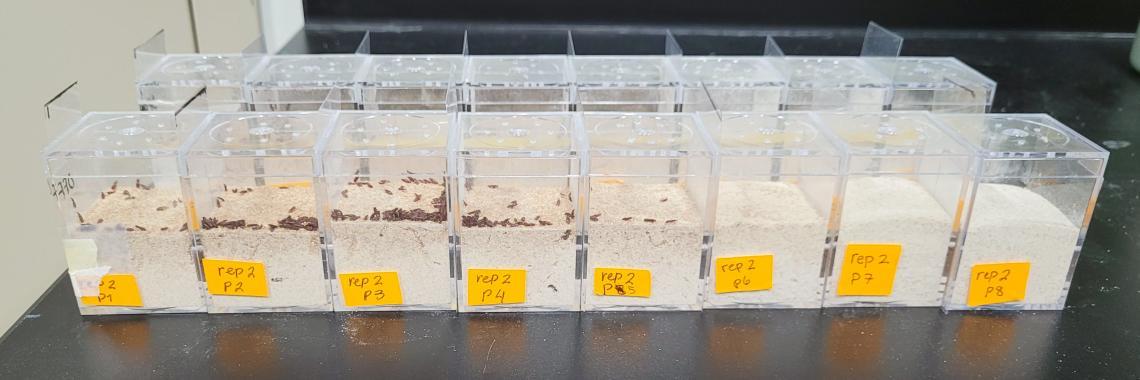
To recreate a dispersal landscape in the lab, Breslin built experimental set-ups using a linear series of plastic boxes connected by small holes that could be opened or closed, allowing the beetles to move between them during specific times. Replicate landscapes were then maintained at three different temperatures – 27.5°, 30° and 32.5° C – to test how heat influences dispersal.
After an initial acclimation period of three weeks, the beetles were given 12 hours to disperse through the system. The set-ups were then disassembled to count how many adult beetles ended up in each box. This process was repeated every three weeks for several months, allowing Breslin to track movement across these mini-landscapes over successive generations.
Similar experimental designs were also used to isolate and test how temperature independently affects movement rate and population growth.
The final results were very clear cut.
“It was surprising how much the data supported our predictions. Warming temperatures led to a faster rate of expansion with both movement and population growth rates being affected,” says Breslin.
This study highlights the critical role of model systems in science, while establishing a foundation for future research on how warming temperatures influence the rate of range expansion. Future studies can build on this work by investigating how broadly these effects apply to different species and determining how these dynamics occur in natural environments outside of a lab setting.
Breslin plans to continue studying movement ecology in her next chapter. She recently received a prestigious NSERC graduate scholarship and will pursue further research on the migration of Pronghorn across roadways as a master’s student at the University of Calgary.
“There’s still so much we don’t understand about how species respond to human disturbance and environmental change, and I’m excited to be part of uncovering those answers.”
Read the full study in the journal Ecology.
Read about other CBS Research Highlights.