M.Sc. Integrative Biology Grad Explores Learning Across Disciplines and Beyond the Classroom
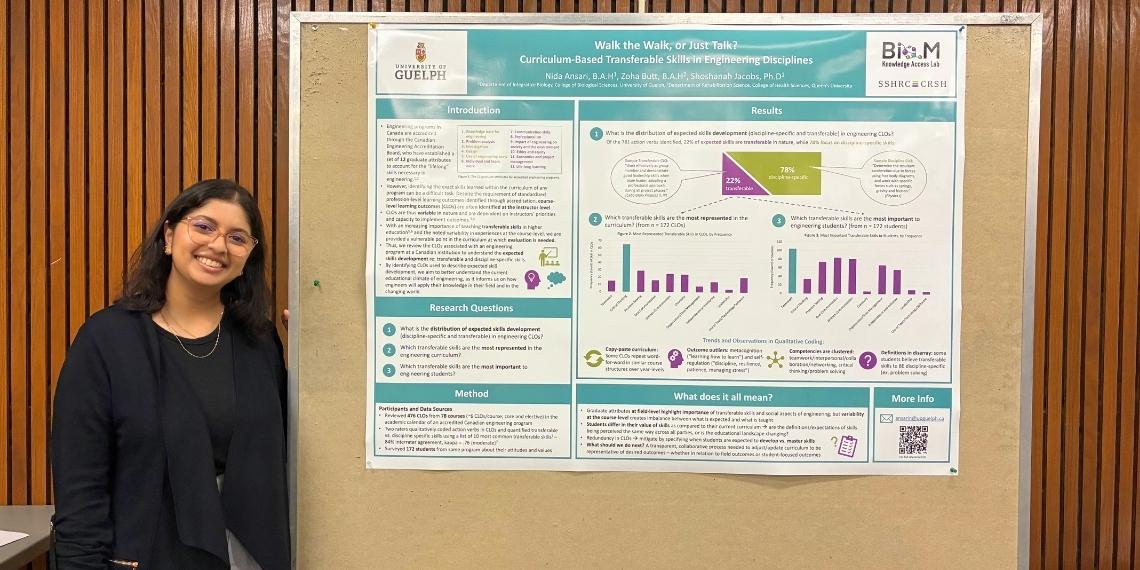
With a B.A. in Psychology and soon graduating with an M.Sc. in Integrative Biology, Nida Ansari brings a fresh perspective to what students learn, and how. Throughout her time at the University of Guelph, she has explored how interdisciplinary education and real-world experience shape students’ ability to tackle complex problems.
Her master’s thesis, “Learning in Context: A Transdisciplinary, Systems-Level Understanding of Contextualized Skill Development in Higher Education,” completed under the supervision of Dr. Shoshanah Jacobs, examines the degree of social and community context teaching and learning in an Ontario university’s engineering curricula, as well as students’ attitudes about the importance of community voices in the design process. Without community consultation, Ansari notes, engineering projects are much more likely to fail to meet the needs of end users.
 Just as her research points to the need for multiple perspectives in engineering education, Ansari herself brings a unique background to her research in the College of Biological Science. With a foundation in the social sciences, she combines interests in educational psychology, teaching and learning, and mentorship with strong qualitative and quantitative research skills.
“I call myself an interdisciplinary guinea pig in that I was willing to take that leap to STEM and put into practice the concepts I was learning about transferable skills,” she says. “In terms of the topic of my research, we characterized the learning experiences of undergraduates in relation to community engagement, and studied how those experiences might affect the decisions that they make in their careers.”
“It brought together a lot of different topics I’ve been interested in throughout university.”
Ansari initially began working with Jacobs, U of G’s Teaching Leadership Fellow in Contextual Education, during her undergraduate degree, where she took a research assistant role supporting a master’s student examining transferable skills in Canadian university curricula. But her connection to Jacobs goes back a year earlier.
Drs. Jacobs and Daniel Gillis were teaching the Ideas Congress (ICON) course, which challenged students across disciplines to develop solutions to community problems. One semester, the class was tasked with helping a local organization, The Grove Youth Wellness Hubs, better meet the needs of youth in the community. Students proposed that The Grove hire a co-op student to develop a youth support training program. The role was posted, Ansari applied, and she spent two consecutive co-op terms there, meeting with community members and developing training modules, including topics on mental health and boundary-setting. Her work with The Grove continued beyond the co-op terms, first as a volunteer coordinator, then youth ambassador leadership mentor.
Education has been a consistent theme throughout Ansari’s undergraduate and graduate studies, reflected in her involvement in teaching and learning committees, including the College of Social and Applied Human Sciences’ Teaching and Learning Excellence Hub Committee and CBS’s Office of Educational Scholarship and Practice. She has also taken on a range of support and mentorship roles, including with the Library, Cultural Diversity, and CBS’s Undergraduate Mentorship Program. In addition, she joined and helped establish the Bio-Ed Graduate Research Group, which brought together graduate students across CBS conducting research on teaching and learning in biology and broader STEM disciplines.
“In a very meta way, my thesis was all about a systems-level understanding of education and I feel like I'm traveling through that system myself,” she says. “It's very cool to experience it and reflect on it.”
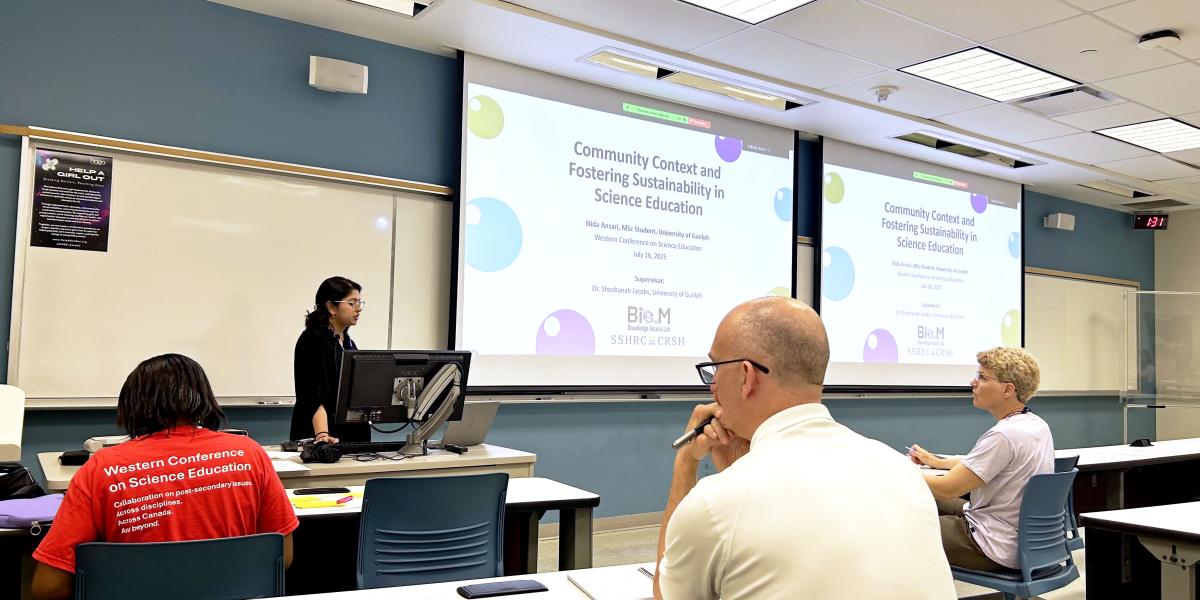
In support of her interdisciplinary graduate studies, Ansari received a Canada Graduate Scholarship from the Social Sciences and Humanities Research Council, as well as several awards recognizing academic excellence, including the Arthur Richmond Memorial Scholarship and the Henry Mandelbaum Master’s Fellowship Award.
Since defending her thesis in November, Ansari has started a job as a Junior Analyst with the Guelph Research Data Centre, as part of Statistics Canada. She maintains her commitment to and passion for research by continuing to work with Jacobs on contextual learning in engineering curricula, now focusing on the University of Guelph’s programs. She also works as a data analyst for Sociology professor Dr. David Walters, and supports external research on transferable skills in postsecondary education.
“I feel really privileged that I was able to join the M.Sc. program and work across multiple disciplines. That’s something, as a university, we’re trying to work toward – not being so siloed in our departments,” she says.
“That was a big thing that I learned in my research. I don't ever want to be so independent that I can't learn from other people. It sounds so cliché, but let’s learn from each other. Because genuinely that is what we discovered, right?”
Ansari will graduate with her M.Sc. in Integrative Biology at convocation in June.