Lean On Me: Men and Women Use Different Strategies to Maintain Balance
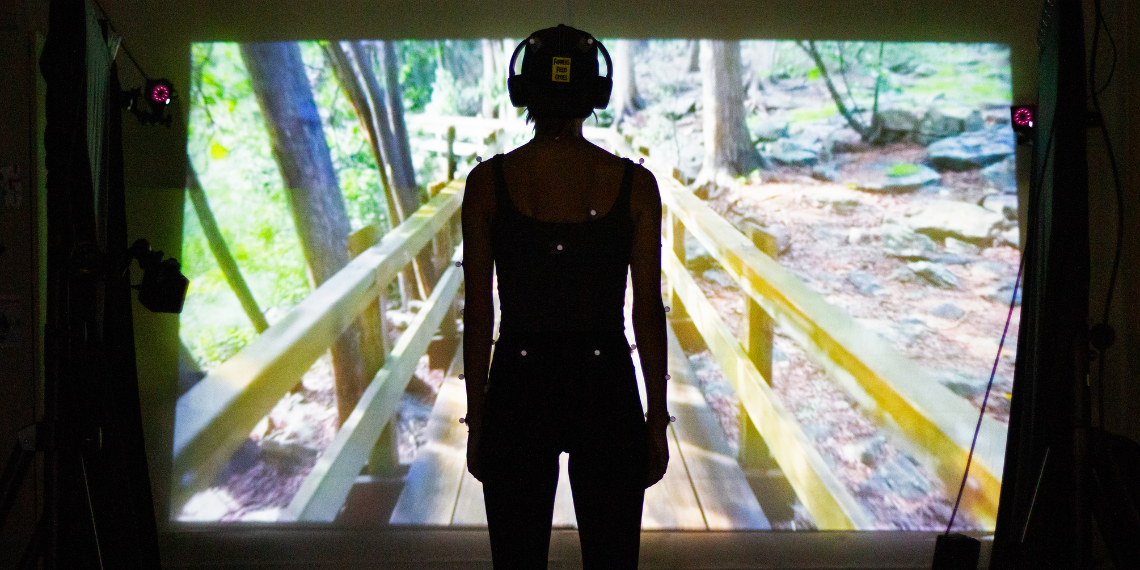
If you want to gain a new appreciation for your body’s ability to stay balanced — even during the simplest tasks — step inside the Gait Biomechanics Lab in the Department of Human Health Sciences.
"There are so many different things that have to work for us to do something as simple as getting up from a chair," says lab researcher Kristen De Melo. "It's only when it starts to go wrong that we realize just how complex a process it is."
 As an MSc graduate and now PhD candidate in the lab, De Melo knows this all too well. Working with Dr. Lori Ann Vallis, De Melo studies the integration of the motor and cognitive components that come together to shape human movement.
It's well known that vision can influence posture and body movements, with a strong interaction seen even at a very young age. For instance, babies just three days old make more crawling or stepping movements when suspended above a moving video than a still one. However, it's not clear how strong this relationship remains into adulthood.
It’s an important question, because a rapid decline in vision and motor integration in older adults indicates a range of neurological issues that might be at play. Ideally, medical professionals would have a standardized test to help diagnose such a decline — but before a test like this can be developed, researchers first need to fully understand how this integration works.
This is what’s driving De Melo's PhD work.
"If we control visual input in an environment where people aren't moving at all, we can see the relationship between vision and how the body moves," she says. This, in turn, can indicate whether the strong relationship seen in kids persists into adulthood, and to what extent.
Together with Julia De Oliveira (then a fourth-year Human Kinetics student, who has since started her MSc in the lab), De Melo exposed young, healthy adults to a series of increasingly complex immersive videos: walking in an indoor hallway, strolling along an outdoor boardwalk, and hiking an outdoor trail. They also modified the stability of the participants’ stances while watching the videos, progressing from least to most supportive: standing with planted feet, sitting with dangling feet, or sitting with planted feet.
Using electrodes to monitor leg muscle activity and reflective markers on the participants’ clothes, the team then took two important measurements. First, they looked at how much each subject swayed, a movement associated with maintaining balance. They also measured how much the lower limb muscles became activated, which similarly indicates the body’s attempt to restore balance.
 The researchers found that vision does indeed continue to influence movement and balance in adulthood. However, they also found that there were key differences between female and male participants. For example, female participants exhibited more back-and-forth sway while standing for all the video conditions compared to no video, whereas males only experienced such sway for certain videos and certain stances.
The team also found an intriguing difference in which lower limb muscles are activated when attempting to restore balance. In females, the greatest increase in muscle activation occurred in the vastus lateralis, which is part of the quadriceps in the thigh, while in males it was in the gastrocnemius, one of the muscles in the calf.
These findings are consistent with past work in the field showing that women rely more on visual cues to maintain balance. However, this study reveals new, interesting details regarding differences in how males and females use visual input to stabilize their bodies.
There's clearly more to investigate in this area, and De Melo is just getting started. Her next step is to use virtual reality (VR) to deliver the immersive videos, as opposed to the projection screens used this time around. She also plans to work with older adults, using VR to train them to perform a balance-related task and see if the training can improve their performance. Eventually, the hope is that this work can help create a diagnostic test for older adults and detect neurological health problems earlier.
So the next time you're walking down the street, balancing on one leg at yoga, or even getting up from a chair, take a minute to appreciate how many things are at play every single time we move.
Read the full study in the journal Experimental Brain Research.
Read about other CBS Research Highlights.