Rural History Roundtable
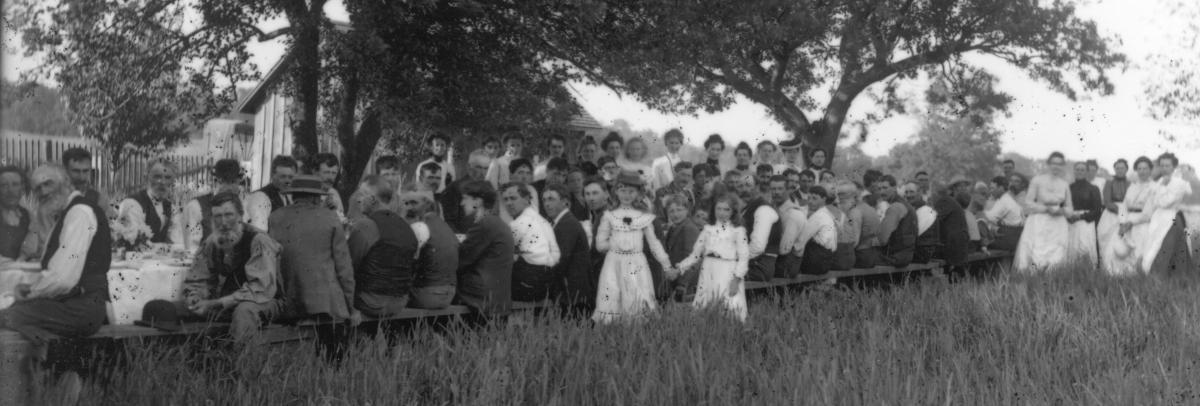
Photograph: Large group eating meal after raising barn, Stephen Sylvester Main collection, University of Guelph Library, Archives, and Special Collections, Agricultural History (XA1 MS A230 #214)
The Rural History Roundtable is a speaker series that has been in operation since 2002. It hosts scholars of international repute and provides a venue for graduate students to present their latest research. It is vertically intergrated drawing into its fold undergraduates, graduates, post-docs, faculty, archivists, alumni, and other members of the public.
All are welcome to attend!
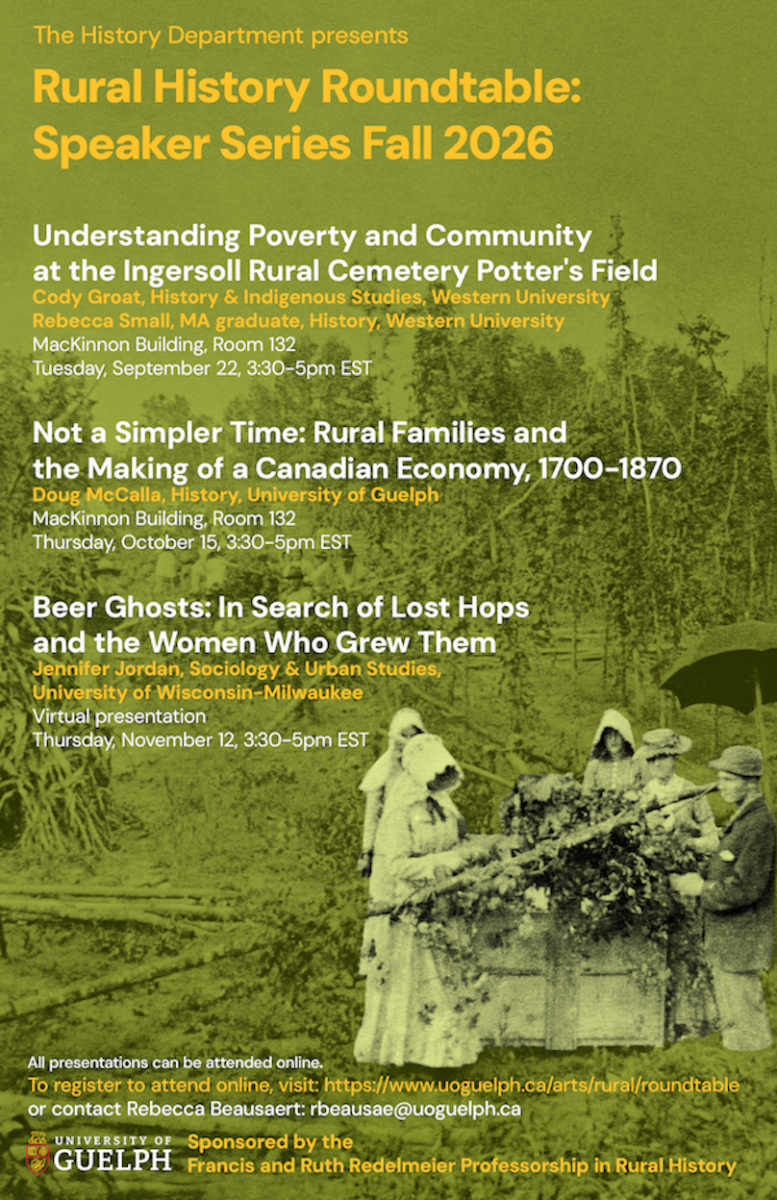
Our next Rural History Roundtable for 2026-27 will take place Thursday, October 15 from 3:30-5:00pm EST. This presentation will be in a hybrid format. The in-person presentation will take place at Room 132 of the MacKinnon Building on the University of Guelph campus. If you wish to attend online, please pre-register on the Eventbrite page. Registering for a free ticket will add you to a list of attendees who will receive an email on the afternoon of October 15 containing the Zoom link to the online presentation. Please register at least 24 hours before the presentation to ensure you receive the Zoom link in time.
Presenter: Dr. Douglas McCalla (Professor Emeritus, History, University of Guelph)
Title: "Not a Simpler Time: Rural Families and the Making of a Canadian Economy, 1700-1870"
Description:
Drawing on his recent essay collection, Not a Simpler Time, McCalla makes the case for rural complexity.
Although the great majority of Canadians lived in rural communities until the early 1900s, rural life has often been dismissed as marginal to the country’s economic development. In this presentation which draws from his new collection of essays Not a Simpler Time: Essays on Canadian Rural and Economic History (MQUP 2026), McCalla challenges this view, arguing that the strategies, skills, and work of rural families were the backbone of the economy. In making this case, he illustrates how established narratives can constrain new approaches to the past.
Highlighting the complexities of rural economies in early Canada, the growth of the colonies that joined Confederation in 1867 is shown to have relied far more on agriculture than on natural resources – a reality overlooked by proponents of the enduring staples thesis. Building on this argument revises old stories: neither the timing nor the character of Ontario’s economic growth stemmed from natural resources; the emergence of a new economic core in the colonies contradicts the perception that they were essentially an imperial periphery; and the First World War did not, in fact, transform the economy as often imagined. Most of all, a close look at the worlds of rural families reveals the complexities of lives that have often been imagined as “simple.”
For more on the book which the presentation draws from: https://www.mqup.ca/Recent-News/2026/07/Not-a-Simpler-Time-by-Douglas-McCalla
Questions? Please contact:
Dr. Ben Bradley
ben.bradley@uoguelph.ca
Dr. Rebecca Beausaert
rbeausae@uoguelph.ca


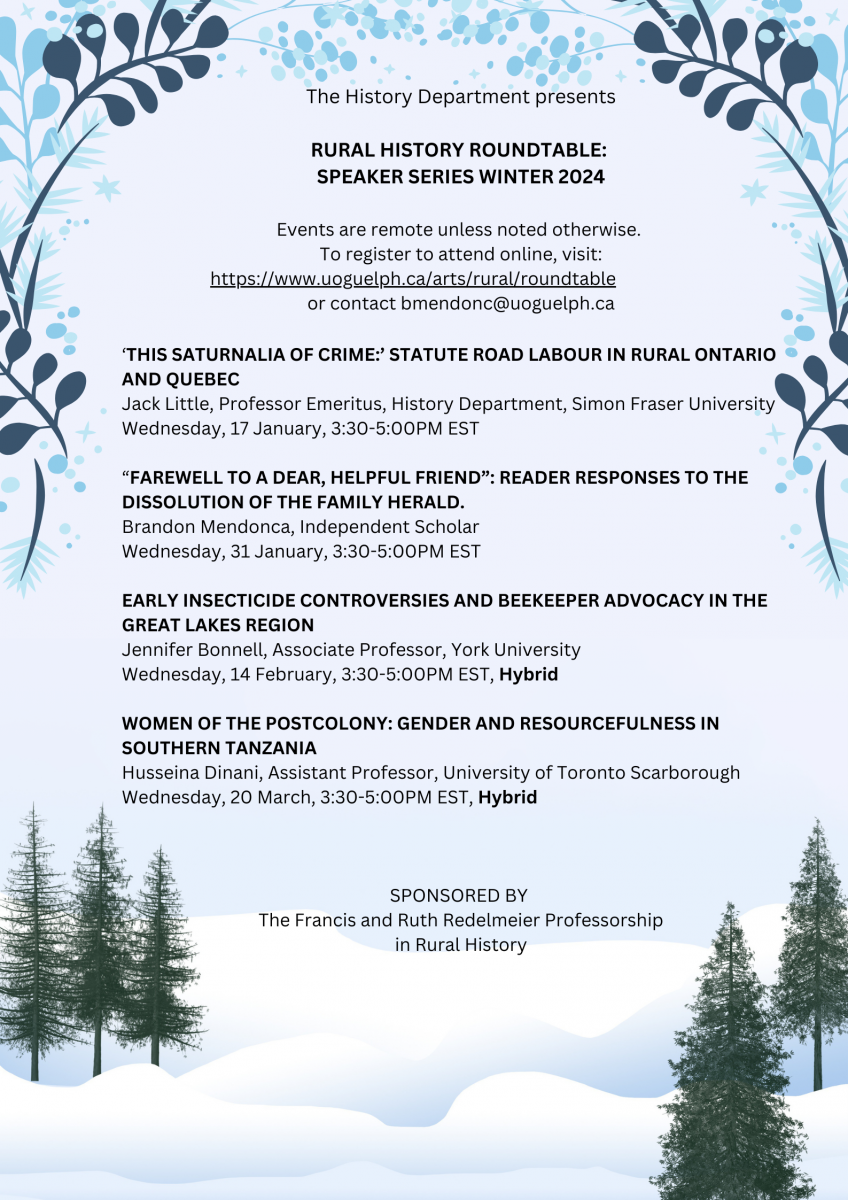
For a list of past Rural History Roundtable speakers, see here.