The WELL-E Approach to Data-Driven Inclusive Innovation: An AI-Powered Digital Living Lab for Animal Welfare Co-Developed with and for End Users
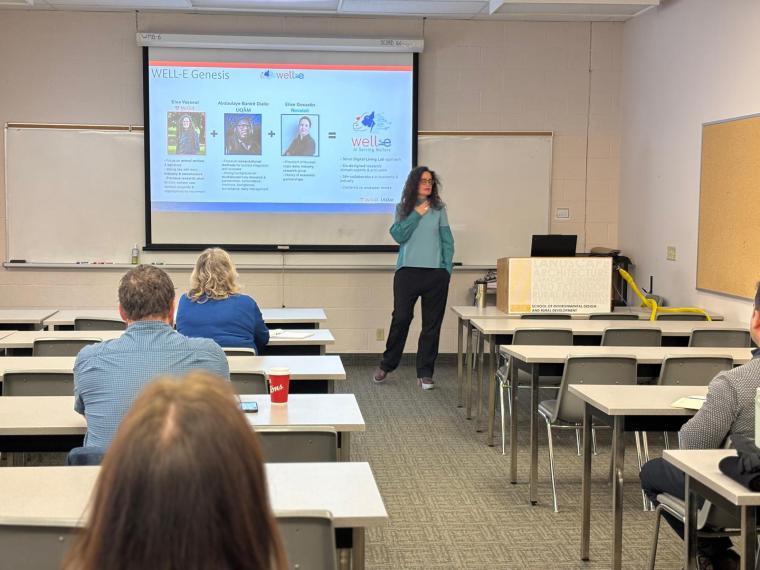
The School of Environmental Design and Rural Development (SEDRD) at the University of Guelph hosted a seminar on February 25, 2026, featuring Dr. Elsa Vasseur, Associate Professor in the Department of Animal Science at McGill University. Intentionally held in-person to support knowledge sharing, the event brought together students and faculty interested in emerging technologies, livestock systems, and the future of animal welfare research.
Dr. Vasseur’s seminar, titled “The WELL-E Approach to Data-Driven Inclusive Innovation: An AI-Powered Digital Living Lab for Animal Welfare Co-Developed with and for End Users,” introduced the WELL-E initiative, an interdisciplinary research program that integrates animal science, artificial intelligence, and stakeholder engagement to develop innovative tools that improve animal welfare in livestock systems.
A central theme of the talk was the concept of a Digital Living Lab (DLL), a collaborative research environment designed to collect and analyze data directly from real farm settings. Through this approach, researchers are able to capture real-time behavioral and environmental data, integrate multiple data streams, and develop AI-driven tools that support decision-making for animal welfare and longevity in livestock production.
Dr. Vasseur explained how modern technologies enable researchers to transform behavioral video recordings into scientific insights through processes such as video preprocessing, behavioral annotation, and advanced data analysis. These tools make it possible to automate measurements, scale research across multiple contexts, and uncover patterns in animal behavior that were previously difficult to detect. The presentation also explored the concept of movement opportunity in dairy cows, which refers to animals’ ability to move freely and express natural behaviors. Dr. Vasseur discussed how evolving Codes of Practice for dairy cattle welfare are encouraging housing systems that provide greater freedom of movement and social interaction. Understanding how cows adapt to these changes requires both quantitative behavioral data and qualitative insights from producers and stakeholders.
Another key message of the seminar was the importance of interdisciplinary collaboration. Animal science and computer science operate with very different research structures—while animal science relies on controlled trials involving live animals, computer science typically works with large datasets and flexible experimentation timelines. Bridging these differences requires effective communication, shared frameworks, and collaborative research models, which the WELL-E project actively promotes.
Dr. Vasseur also highlighted the role of pilot farms, where new technologies and research tools are tested in real-world conditions. These environments allow researchers to evaluate how innovations perform in practice while working directly with producers to ensure that solutions remain practical and applicable. Because the project relies heavily on large datasets and digital infrastructure, data governance, security, and privacy are also central considerations. The WELL-E initiative incorporates robust data management strategies to ensure that research data remains secure while maintaining accessibility for collaborative research and innovation. Seminar: Beyond technological innovation, the project also focuses on capacity development and training. Through interdisciplinary education and collaboration, WELL-E aims to support the emergence of a new generation of researchers capable of working at the intersection of animal welfare science, artificial intelligence, and digital agriculture.
The seminar concluded with a discussion on how inclusive, data-driven innovation can transform the way animal welfare is studied and managed in livestock systems. By combining technological advances with stakeholder knowledge and collaborative research approaches, initiatives such as WELL-E aim to improve both animal well-being and the sustainability of modern agricultural systems.
Through events like this seminar, SEDRD continues to foster dialogue on digital agriculture, responsible AI, and interdisciplinary innovation, providing students and researchers with opportunities to engage with the technologies shaping the future of agri-food systems.
Learn More
For readers interested in learning more about Dr. Elsa Vasseur’s research and the WELL-E project, please explore the following resource links:
- WELL-E Project.
- Research and Innovation Chair in Animal Welfare and Artificial Intelligence (WELL-E) – LinkedIn.
- Dr. Elsa Vasseur – LinkedIn Profile.
These platforms provide further information about the WELL-E Digital Living Lab initiative, AI-enabled tools for monitoring livestock welfare, and ongoing interdisciplinary research integrating animal science, artificial intelligence, and on-farm innovation.