Landscape Architecture Field Trip to Montréal
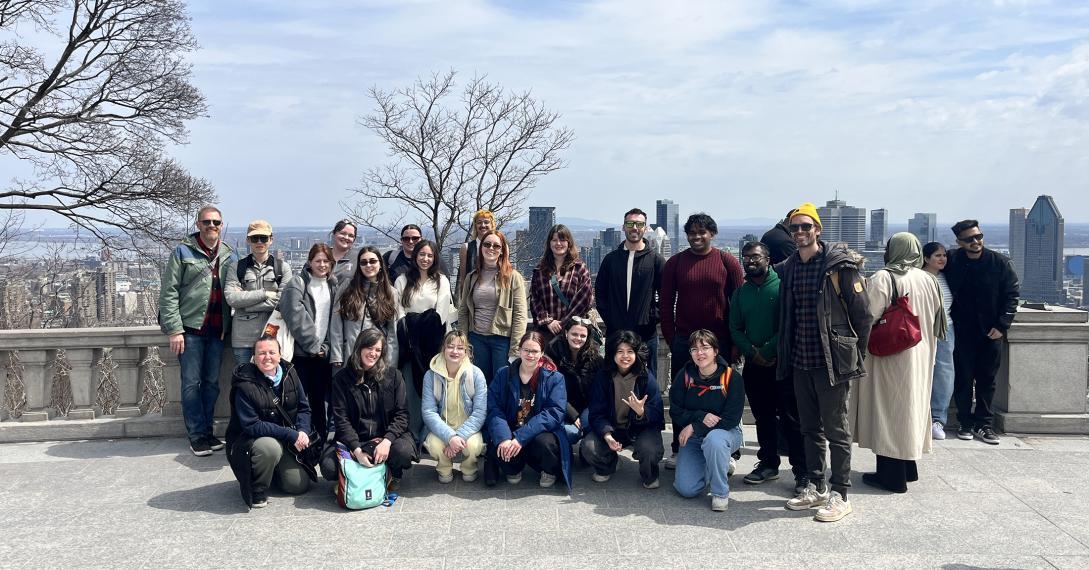
From April 20-23, 2026, a group of twenty BLA and MLA University of Guelph students, led by faculty members Brendan Stewart, Heather Schibli, and Steven Clarke, visited Montréal, Québec to experience the city’s vibrant parks and public spaces. The experience gave students the opportunity to explore some of the city’s most iconic sites firsthand while benefiting from faculty guidance and expertise throughout the trip. With costs offset through generous support from the OAC Learning Trust, the four-day trip featured two full days of walking tours during which we explored Old Montréal, the Old Port, and the Mount Royal and McGill areas, while also connecting with professional practices in the city.
On our first day, the group had the opportunity to visit ERA Architects, where students were introduced to the firm’s work in heritage conservation and adaptive reuse. This visit provided valuable insight into how historical preservation is approached in a contemporary urban context, and students were exposed to an initiative called “Ceramiques Architecturales du Metro de Montréal,” where ERA is researching and documenting the 1960s era ceramic tile design work that defines the metro system, raising awareness about its public value to inform its conservation over time.
 Image: Jan Kubanek, Principal at ERA Architects Montreal introduces our group to their practice.
Next, we continued our walking tour of Old Montréal, moving through a series of historic public squares including Place Vauquelin, Place Jacques-Cartier, Place d’Armes, and Place Royale. These locations offered a strong introduction to the city’s colonial roots, civic design, and vibrant street life, and the group enjoyed exploring each site, noticing design details, and observing public use patterns. After pausing for lunch at Café Titanic, we explored the Old Port and surrounding areas, including the archaeological site of Canada’s former Parliament, the Lachine Canal, Square Victoria, and installations like La Joute. The day offered a balance of structured movement with time for informal exploration and photography.
The second day shifted focus to the Mount Royal Park / Parc du Mont-Royal and parts of the McGill campus, but the day began with a visit to the firm CCxA, where their team provided a presentation of their work and design philosophy, and a tour of their studio which overlooks downtown and the iconic Mount Royal.
 Image: Marc Hallé, Principal at CCxA, shares a presentation about the firm’s philosophy, and students had the chance to look at mockups and maquettes of elements from the firms projects.
After this inspiring visit, the group picked up a pre-ordered picnic lunch and started our ascent of the mountain, with an initial stop in Parc Jeanne-Mance. As we climbed, students visited key landmarks, including the Sir George-Étienne Cartier Monument, the Camillien-Houde lookout, and the Mount Royal Cross. The morning concluded at the Kondiaronk Belvedere, where sweeping views of the city offered a chance to reflect on Montréal’s layout and the connections between the sites visited the previous day.
 Image: Our group hiking up Mount Royal.
Here, we were joined by City of Montréal landscape architect Katherine Davies, who brought us to see a recent wetland rehabilitation project adjacent to the Belvedere, and talked about her work as a public-sector LA in stewarding and conserving the Park over many years.
 Image: City of Montréal Landscape Architect Katherine Davies talking about wetland restoration, habitat and water quality in the park.
On our way down the mountain, we visited with Université de Montréal landscape architecture design studio instructor Olivier Phillipe, and Jan Kubanek of ERA Architects to learn about a large-scale district rehabilitation project at the Old Vic hospital, involving adaptive re-use of old buildings and new landscape spaces to better connect the McGill Campus to the mountain landscape.
 Image: A view of bedrock blasting to make way for new buildings and landscapes at the Old Vic site adjacent to McGill University.
To deepen engagement throughout our tour, students were assigned partners and given two sites each to research in advance. At each stop, pairs were responsible for presenting their assigned locations to the group, sharing key historical, architectural, and cultural insights. This approach encouraged active participation and helped foster a stronger sense of ownership over the learning experience.
 Images: LA students basking in the long-awaited spring sunshine.
Throughout the trip, students engaged with the built environment in a hands-on way, strengthening their understanding of urban planning and design, historical context, and spatial relationships. The experience also encouraged collaboration and shared observation, as students documented their journey through photos and engaged in discussion. We learned a lot and also had a lot of fun. The image below captures the class gathered beneath the 20-foot-tall dodo bird sculpture in Michel-Belanger Park (The Song of the Dodo by artist Myfanwy MacLeod), a moment that reflects both the educational and lighthearted spirit of the trip.
 Images: Future landscape architects pretending to be hatching dodo eggs in Michel-Belanger Park.