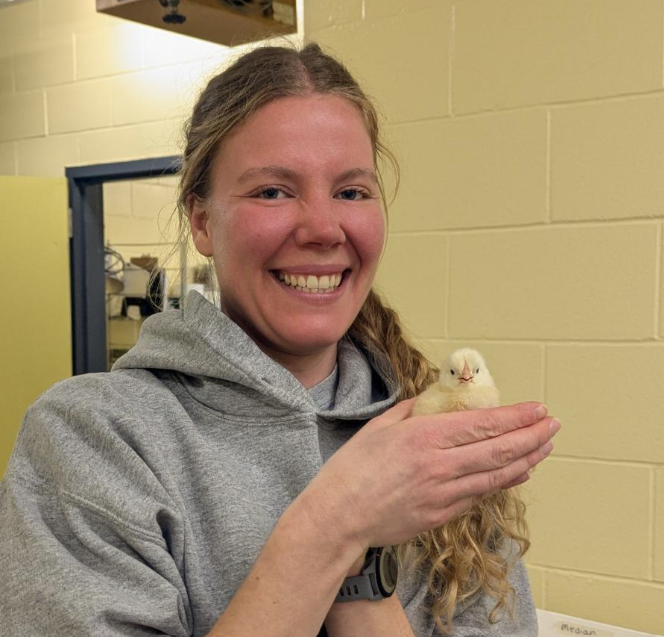
When you think of a healthy egg-laying hen, the microscopic organisms in her gut might not be the first thing that comes to mind. For University of Guelph PhD in Animal Biosciences student Lea Nicklas, these organisms, known collectively as the microbiota, are where the story begins.
Nicklas, a PhD candidate in the Department of Animal Biosciences at the Ontario Agricultural College (OAC), is exploring the link between a hen’s gut microbiota and their mental health and stress. This important connection might reduce one of the poultry industry’s most persistent animal welfare challenges - feather pecking.
“Feather pecking starts as a small behaviour where one hen plucks a feather from another, but it can escalate quickly,” Nicklas explains. “Once it begins, it spreads through the flock like a chain reaction. Hens lose their feathers, suffer painful injuries, and sometimes the damage is so severe that it can lead to death.”
Feather loss isn’t just a welfare concern. It affects a bird’s ability to regulate temperature and can reduce productivity, leading to lower egg output.
“The root cause of feather pecking is stress,” says Nicklas. “If we can better support hens when they are stressed, we can make flocks healthier and more productive.”

Nicklas is also a member of the U of G’s Campbell Centre for the Study of Animal Welfare, an interdepartmental centre uniting faculty and students whose research focuses on animal behaviour and welfare. Nicklas runs the centre’s student chapter as one of its co-presidents.
Studying the hen’s gut-brain connection
A growing body of research shows that the microbes living in the gut of humans can influence mood, anxiety, and overall mental well-being. Hens are no different.
“Hens have a similar microbiota-gut-brain relationship,” says Nicklas. “The bacteria in their digestive system communicates with the brain through neurons, hormones, and chemical precursors for neurotransmitters like serotonin. Serotonin in the brain helps regulate mood, appetite and more. When the gut microbiota is balanced, the hen is more resistant to stress and therefore less likely to peck its flockmates.”
To test this theory, Nicklas and her supervisor Dr. Alexandra Harlander are examining ways to improve the gut health of laying hens using prebiotics — compounds that feed beneficial bacteria in the gut. Their focus is on a specific prebiotic (called galacto-oligosaccharides), made from a natural byproduct of cheese manufacturing. They’re working with international partners including an avian neuroscientist from Purdue University, an immunologist specializing in gut microbiota from the University of Alberta, a biochemical immunotoxicologist from the Medical University Innsbruck to test this theory.
By introducing this prebiotic into the hen’s diet via the drinking water, Nicklas is hoping to see a happier, less stressed hen.

“Prebiotics encourage the growth of ‘good’ gut bacteria,” says Nicklas. “We’re studying whether this same ingredient can improve gut balance in hens, reduce stress, and ultimately prevent feather pecking.”
In their preliminary trials, Nicklas and her team added the prebiotic to the diets of laying hens during their most productive egg-laying period. The early findings are encouraging: beneficial bacteria increased in the gut and two out of three trials showed that hens maintained their feather cover, meaning less plucking. The serotonin levels in the hen’s brain also increased during the trial period.
“These results suggest there’s a connection between beneficial gut microbes, brain chemistry, and behaviour,” says Nicklas. “It’s exciting because it shows how nutrition can be used to promote hen welfare in a practical, cost-effective way.”
Nicklas’s work is already earning international attention. In February 2025, she was awarded the Blair-Curtius-Pfleiderer-Wachter Award at the 41st International Winter Workshop on Clinical, Chemical, and Biochemical Aspects of Pteridines at the University of Innsbruck in Austria.
The next phase of her research will focus on aging hens, a group that faces additional challenges as their gut health and immunity naturally decline with age.
“If we can support a healthy good microbiota in older birds and maintain their feather cover, we might help them stay healthier and lay longer, which benefits both the animals and the producers,” she says.
This research is funded by the Ontario Agri-Food Innovation Alliance, a collaboration between the Government of Ontario and the University of Guelph and took place at the Ontario Poultry Research Centre, which is owned by Agricultural Research and Innovation Ontario, an agency of the Government of Ontario.
From law to animal science
Originally from Germany, Nicklas completed an undergraduate degree in law and linguistics before moving abroad to work in the US where she volunteered at an animal shelter.
“The experience in the animal shelter changed everything for me,” she recalls.
She came to the University of Guelph for her bachelor’s degree and is now completing her PhD in Animal Biosciences under Dr. Harlander’s supervision. Her long-term goal is to merge her background in law and public policy with her scientific training to influence how animal welfare is supported and regulated globally.
While the research is still ongoing, Nicklas believes her work has the potential to transform poultry welfare and management, minimize injuries, and enhance farm productivity.
“When we support animals’ natural systems, everyone benefits: the hens, the farmers, and the industry as a whole.”