Designing with intelligence: OAC prof explores how AI can shape the future of landscape architecture

From parks to restored natural habitats, landscape architects help sustainably shape the outdoor spaces that connect people and land. While the discipline has traditionally relied on hands-on, human-centered methods, it has been slower to adopt emerging technologies like artificial intelligence (AI) or augmented reality. OAC’s Afshin Ashari, assistant professor in the School of Environmental Design and Rural Development, is working to change that.
Ashari is one of the few academics in North America that is exploring how AI can be integrated into the landscape design process. His goal isn’t to replace human creativity with algorithms, but to explore how AI can help designers analyze complex data, make sense of interconnected systems, and ultimately create more resilient spaces.
“There’s a fear that computers will replace creativity, but that’s not what this is about,” says Ashari. “AI can be an instrument to enhance the design process, not a replacement,”
Ashari thinks that AI offers a new kind of design collaborator, one that can help make sense of the enormous amounts of data involved in developing a site.
“When we design, we’re not just thinking about aesthetics,” says Ashari. “We’re layering ecological systems, hydrology, microclimate, circulation patterns, social equity data, policy frameworks, and economic variables on top of each other. AI helps us process these layers together much faster and reveal relationships between people, ecology, and infrastructure that would be very hard to see otherwise.”
That synthesis could help designers make more informed, context-sensitive decisions.

“AI can be used to tailor the design process to the needs of the project,” he says. “We can use it to test ideas, visualize scenarios, or highlight relationships between the land and the people that use it.”
Ashari’s most recent project is exploring how technology can help improve the design process of public parks and other shared spaces.
“Instead of relying on fixed ideas about how people use these areas, I, along with my research assistant, Ramtin Shafaghati, built a prototype that uses AI to determine where people are most likely to gather based on real environmental factors, like temperature, sunlight, shade from trees, and how paths connect,” says Ashari.
Using Grange Park in downtown Toronto as an example, the team divided the park into a simple grid and trained an AI system to predict ideal gathering spots with strong accuracy. They then connected the trained AI module to a small physical model, showing the results in real time.
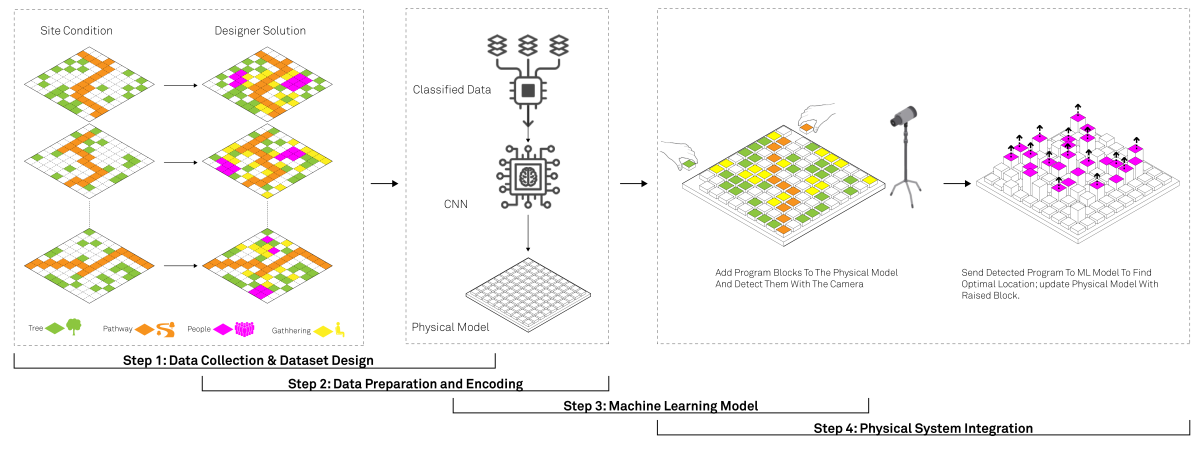
“This allowed us to test and iterate how different conditions might change how people use the space.”
This approach helps compare computer predictions with human judgment and gives a new way to explore how parks could be designed or improved.
Blending STEM with Landscape Architecture
Before becoming a landscape architect, he studied computer science, a foundation that now fuels his passion for exploring how technology can enhance usability and meaning in public spaces.
One of his earlier projects, WE[AR], was an interactive augmented reality installation featured at Toronto’s Winter Stations exhibition, where visitors could explore digital art and stories that reflected themes of solidarity and social connection.
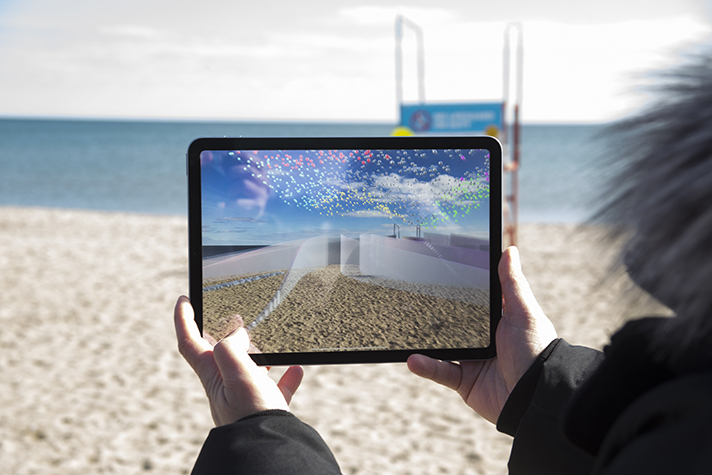
“WE[AR] was about empathy and using technology to bring people together,” he says. “It showed me how digital experiences can add depth and meaning to physical space.”
WINTERACTION, a subsequent installation, expanded on WE[AR] by connecting two installations through AR, allowing audiences in different locations to share a linked interactive experience.
“WINTERACTION is a dual installation in Canada and Iran that uses augmented reality and a shared virtual tree to connect people across distance, symbolizing unity, resilience, and cross-border solidarity,” says Ashari.
Both projects laid the groundwork for his current research, which focuses on how data-driven technology can support the creative process.
Teaching AI in the Classroom
Teaching how to properly use AI to the next generation of landscape architects is critical to the sustainability of the profession, he says.
“Students are eager to learn these new technologies, especially as the profession increasingly recognizes landscape architecture as a STEM discipline,” says Ashari. “Our students need to be fluent in both design thinking and data literacy.”
In one of his undergraduate studio design courses, students were divided into two groups: one half used traditional design methods, and the other half incorporated AI tools into their process. The final projects were blindly evaluated by professional landscape architects, and determined there was no discernible difference in quality between the two groups.
“That experiment told us that AI doesn’t automatically make a design better or worse. It depends entirely on how the designer uses it.”
Ultimately, Ashari hopes his work will help shift the perception of AI from a threat to an opportunity.
“Landscape architecture is about designing the world we live in,” he says. “If AI can help us understand that world more deeply, then it deserves a meaningful place in how we design it.”