Agri-Food Policy Legacy Continues with Gift
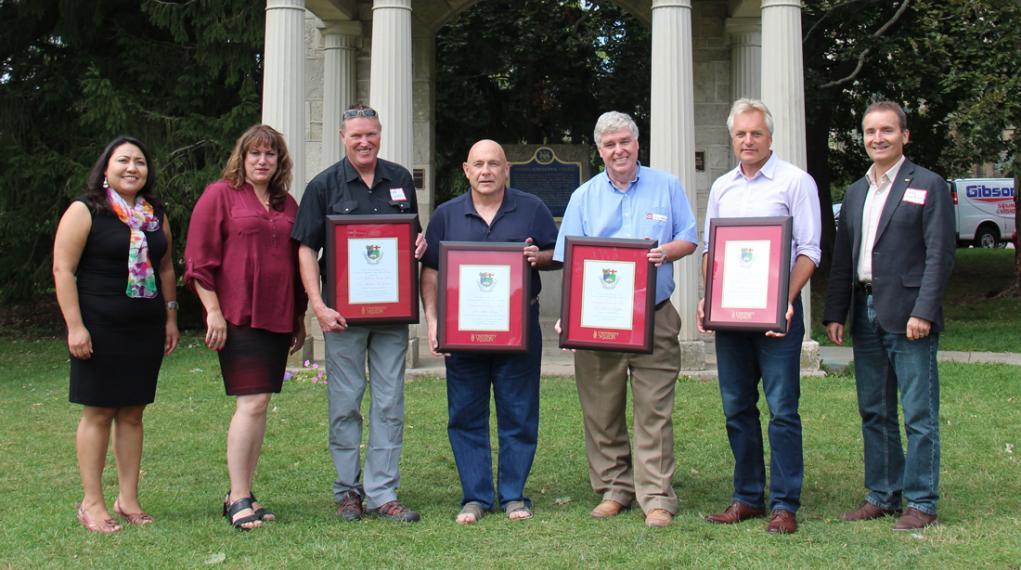
A $450,000 gift from the George Morris Centre will enable new agriculture and food policy research and scholarships at the University of Guelph (U of G).
Seven years after receiving her undergraduate degree, Ashley Honsberger decided it was time to return to school. Her career focus on farm business management was missing the international development link she longed for. To reset her career path, she pursued a Master’s of Science in Capacity Development and Extension (CDE) at the School of Environmental Design and Rural Development.
University is a time for learning, for growth and quite often a time for finding your life partner. Like so many young men and women who attended the University of Guelph during the late 1950s, George and Lorna Roberts found each other. George was enrolled in the Ontario Agricultural College, while Lorna studied in the Macdonald Institute. With five boys for every girl on campus at the time, George considers himself quite fortunate.
Whether they’re scrambled, boiled, fried or whipped into an omelette, eggs are a favourite staple of the Canadian diet. Over 1,000 egg farmers contribute $1.4 billion to Canada’s GDP every year, but how often does the average Canadian think about what goes into producing an egg?
For hundreds of years, generations of the Klosler family worked off the land in Transylvania, Romania; growing fruit, making wine and raising livestock. In 1921, shortly after the end of WWI, George Klosler’s grandfather came to Canada to earn money for his family. He always planned to return home, but the onset of the Great Depression and WWII prevented him from making the trip he longed for. He continued to work on a tobacco farm in Norfolk County, Ontario with his family a continent away.
Second semester of fourth year is a stressful time for undergraduate students. “In last week’s class you could feel the tension,” explains Prof. Vern Osborne from the Department of Animal and Poultry Science who is currently teaching the Applied Environmental Physiology & Animal Housing course. Vern’s solution to a class full of stressed out fourth years was to mix up one of his class’ format to give them a break. In his March 12 class, he asked his students to become “Flash Mob Solvers”.
The Department of Animal and Poultry Science is pleased to announce Dr. Angela Canovas as the new Beef/Small Ruminant Genomics Professor beginning June 15, 2015.
Upon arriving at the McCracken family home in Scotland, Ontario, we are greeted by their standard schnauzer named Fritz. Friendly, regal and a big part of the family; little did we know how Fritz would play a part in our story. Ron and Doreen McCracken both grew up on farms, and still feel at home in the country today. Their current residence, built in 1993, has some 48 acres. A neighbour farms a portion of the land with the remaining set aside for hobby farming, their garden and a place for Fritz to roam. Ron has kept bees, raised geese and ducks, and even guinea hens, but today he enjoys retirement after a long and interesting career.
In January, Michael Rogers joined the Department of Food Science as an associate professor. Rogers is an alumnus of the University of Guelph, attaining both his MSc and PhD in the department. Prior to returning to the University of Guelph, he held faculty positions at Rutgers University and the University of Saskatchewan and as the Center Director for the Gastrointestinal Physiology Center at New Jersey’s Institute of Food, Nutrition & Health.
The School of Environmental Design & Rural Development's (SEDRD) Capacity Development and Extension (CDE) program recently donated its entire radio production studio to CFRU 93.3 FM, the University of Guelph campus radio station. The donation was arranged by Prof. Helen Hambly Odame and included all audio production hardware and software previously installed in the school's Media Lab. A preliminary estimate places the value of the equipment donated at approximately $62,000. The equipment includes broadcast microphones, a mixing console, processing hardware and software, computers and monitors, patch bays, cables and connectors, monitor speakers, and more.